Moon Cloud and Star: A Quietly Confident Embroidery Design
As someone who’s stitched hundreds of designs across apparel, home goods, and boutique merchandise—then shipped them to real customers—I approached Moon Cloud and Star with quiet curiosity. Not hype. Not assumptions. Just the question: *Will this hold up—not just in the hoop, but in the hands of someone who paid for it?*
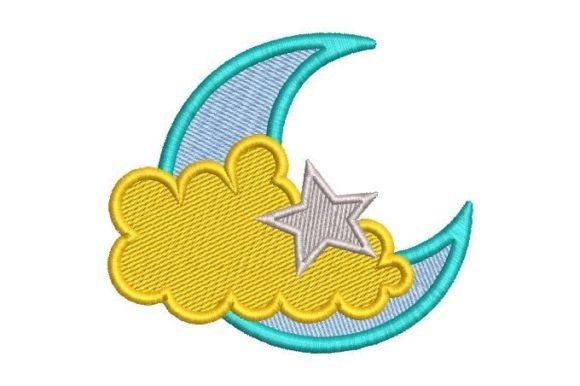
I tested it on a linen-cotton tea towel first—the kind I’d sell at a local craft fair or list as a limited-edition holiday gift. The design landed softly: a crescent moon cradling a small cloud, with three scattered stars trailing behind. No words. No borders. No busy filler. Just shape, rhythm, and gentle contrast. It felt like a breath—calm, intentional, and quietly memorable.
What This Design Actually Wants to Be
Moon Cloud and Star isn’t shouting. It’s leaning in. Its strength lies in restraint: balanced negative space, smooth satin stitch curves on the moon’s edge, subtle fill stitch gradients in the cloud, and clean running stitch stars that read clearly even at 2.5 inches wide. It doesn’t demand attention—it earns it through consistency and clarity.
This is a bed-adjacent design in spirit, yes—but not because it’s meant only for pillowcases or duvet covers. It’s suited to anything that invites pause: nursery mobiles, baby onesies, meditation cushion covers, bedtime storybook tote bags, or minimalist aprons for small-batch bakeries. Its mood fits slow-living branding, indie bookshops, holistic wellness studios, and Etsy sellers building cohesive, tactile product lines.
Where It Shines in Real Projects
- Custom apparel: On a medium-weight organic cotton sweatshirt, Moon Cloud and Star stitched cleanly with light tear-away stabilizer. The satin stitch held its sheen without puckering—even over the slight seam at the shoulder yoke.
- Embroidered patch: Hooped on twill-backed fusible web, it became a ready-to-iron patch for denim jackets or backpacks. Stars stayed sharp; no thread nesting in corners.
- Baby embroidery: Tiny but legible on a 100% cotton receiving blanket (with soft cutaway stabilizer), it read as tender—not fussy—when photographed for an Instagram listing.
- Holiday gift: Paired with a simple “Sweet Dreams” script in a separate file, it elevated a handmade ceramic mug sleeve from craft-fair staple to keepsake-tier.
- Digital product preview: In a printable mockup for an Etsy shop, it translated well across light and dark fabric swatches—no need to tweak thread colors for visibility.
Where to Pause—and Test First
Like any thoughtful machine embroidery design, Moon Cloud and Star asks for intention—not just execution.
On stretchy fabric (like ribbed knit onesies), I added a light layer of wash-away stabilizer beneath the cutaway—otherwise, the cloud’s fill stitch pulled slightly at the edges. On dark fabric, I swapped standard white thread for a matte ecru; the contrast softened beautifully without losing definition. And on curved surfaces like structured caps? I skipped it. The layout isn’t optimized for high-crown distortion—the stars would compress unevenly.
It also doesn’t love tiny hoop sizes. At under 3 inches wide, the smallest star begins to lose its crispness. If you’re planning a micro-patch or cuff detail, check the original embroidery file for stitch density in those points—and always run a test on scrap before committing to your final piece.
Why It Builds Trust—Not Just Decoration
Customers don’t buy stitches. They buy meaning, care, and coherence. Moon Cloud and Star supports that because it looks *designed*, not assembled. There’s intention in how the moon’s curve mirrors the cloud’s underside. There’s balance in how the stars fall—not symmetrical, but weighted with visual gravity. That kind of nuance reads as professionalism, especially in a handmade product where buyers expect craftsmanship, not just charm.
For an Etsy seller or small shop product, that matters. A customer scrolling past fifty “moon” designs will pause at one that feels resolved—not cutesy, not generic, but *considered*. It also scales well: use it solo on a tea towel, pair it with a monogram for a personalized gift, or repeat it subtly along a blanket border. That flexibility makes it strong design assets for a growing craft business.
Practical Designer Notes Before You Stitch
- Test on scrap fabric first—especially if using textured weaves like burlap or terry cloth. Fill stitch can sink or blur.
- Check thread color contrast against your base fabric in natural light—not just screen light. What reads well digitally may disappear on oatmeal linen.
- Review stitch density in the cloud area. Dense fills hold up better on items that’ll be washed (like kitchen towels), but may stiffen delicate baby items.
- Confirm hoop size before digitizing adjustments. Some versions of Moon Cloud and Star include multiple sizes—verify which you’re using.
- Inspect small details in your embroidery software: are star points fully formed? Is the moon’s inner curve smooth at low zoom?
- Try black-and-white mockups to assess silhouette strength—this design relies on shape as much as texture.
- Use proper stabilizer for your fabric type. Light cutaway for stable wovens; soft tear-away for knits.
- Verify licensing before selling finished items or bundling the digital embroidery file in a commercial kit.
In short: Moon Cloud and Star isn’t flashy—but it’s reliable. It won’t distract from your brand voice; it’ll deepen it. Whether you’re stitching a single personalized gift, prepping a batch of tote bag designs, or building a library of commercial embroidery assets, this is the kind of embroidery design that works quietly, consistently, and well.