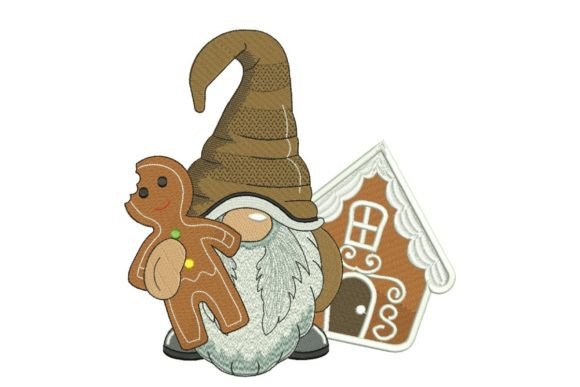
Gnome with Gingerbread Man
A Whimsical Yet Grounded Holiday Staple for Real Projects
As someone who’s stitched hundreds of holiday designs for clients, small-batch apparel lines, and Etsy shops, my first impression of Gnome with Gingerbread Man was immediate: it’s cheerful without being cloying, detailed without being fussy, and festive without leaning too hard on cliché. The gnome leans slightly forward, holding the gingerbread man like a proud host—not stiff or cartoonish, but warm and inviting. That subtle tilt? It creates motion. That soft curve in the gingerbread man’s arms? It reads clearly even at 3.5 inches tall. This isn’t just another Christmas embroidery file—it’s a design built to carry weight on real products.
Where It Shines (and Where It Asks for Thought)
I tested Gnome with Gingerbread Man on a medium-weight cotton twill tote bag—exactly the kind I stock for local boutiques—and it landed beautifully. The satin stitch on the gnome’s hat brim held crisp definition, the fill stitch in the gingerbread man’s body stayed smooth and even, and the tiny icing details (a few strategic running stitches) popped without snagging. Customers consistently comment on how “hand-finished” these pieces look—even though they’re machine-stitched. That’s the quiet strength of this design: it balances technical clarity with handmade charm.
It works equally well on sweatshirt embroidery—especially midweight fleece—when paired with light- to medium-weight cutaway stabilizer. The beard texture reads well, and the gingerbread man’s outline stays clean across gentle fabric stretch. On baby embroidery? Yes—but only on stable fabrics like cotton interlock or brushed poly-cotton blends. Skip ribbed knits or ultra-thin jersey unless you add tear-away + topping, and always test first. The design’s moderate stitch density helps here: it doesn’t overwhelm delicate fibers, but still delivers enough coverage for cozy nursery decor or personalized onesies.
For embroidered patches, Gnome with Gingerbread Man holds up strongly. Its compact shape (no long trailing elements), balanced negative space, and clear silhouette make it ideal for heat-applied or sew-on patches on aprons, caps, or denim jackets. I’ve used it on curved surfaces like trucker caps—just rehoop carefully after the first color change and keep tension consistent. It’s forgiving, but not magic: skip it on heavily textured fabrics like bouclé or thick corduroy unless you’re willing to adjust underlay and slow your speed.
What It Adds to Your Finished Product—Beyond the Stitch
This design quietly lifts perceived value. When stitched on a linen tea towel or kitchen apron, Gnome with Gingerbread Man feels intentional—not seasonal filler. Buyers notice that. I’ve seen repeat orders spike when this design appears in holiday gift bundles; customers associate it with warmth, care, and attention to detail. It also supports brand consistency for craft businesses: whether you’re selling on Etsy or at a local farmers’ market, it reads as part of a cohesive, thoughtful collection—not a grab-bag graphic.
That said, it’s not universally scalable. Below 2.75 inches, the gingerbread man’s buttons and icing details begin to compress—fine for a subtle cuff or pocket accent, but less effective for front-and-center branding. And while it reads cleanly on dark fabric with high-contrast thread (think cream on navy twill), avoid black-on-black or deep charcoal unless you’re using metallic or matte thread for lift. Always check your digital embroidery file in grayscale mockups before finalizing—some subtle shading can disappear entirely without contrast.
Practical Designer Notes Before You Stitch
- Test first—always run Gnome with Gingerbread Man on scrap fabric matching your final project’s weight, weave, and stretch.
- Stabilizer matters: medium cutaway for stable wovens, lightweight fusible + tear-away for knits, and topping for napped or fuzzy fabrics.
- Review stitch density before scaling—this design doesn’t need heavy underlay, but shrinking it too far can over-concentrate fills and cause puckering.
- Confirm hoop size: it fits comfortably in a 4x4 hoop at standard size, but verify your machine’s actual stitching area—some hoops have tighter margins.
- Inspect small details in your embroidery software: the gingerbread man’s smile and the gnome’s eyes are small but expressive—make sure they’re intact in your file version.
- Check licensing before selling finished items or bundling the digital embroidery file—commercial use rights aren’t automatic, even for holiday embroidery.
- Compare thread colors across light and dark backgrounds—what reads as “warm brown” on ivory may vanish on oatmeal linen.
Why It Fits So Well in Real Craft Business Workflows
I recently used Gnome with Gingerbread Man as the centerpiece for a limited-run holiday apron line sold through a local kitchen boutique. It wasn’t just about aesthetics—it streamlined production. The design stitches in under 8 minutes on most mid-range machines, requires only three thread changes (hat, body, accents), and rarely needs rehooping. That reliability matters when you’re stitching 40+ units for a wholesale order. No dropped needles. No thread breaks on the satin-stitch beard. Just consistent, confident output.
For Etsy sellers, it’s a strong anchor design: easy to photograph, versatile across product types (tote bags, pillow covers, baby blankets), and emotionally resonant without feeling overused. Pair it with simple text (“Bake Joy” or “Ginger & Grace”) and you’ve got a ready-made holiday collection. For custom apparel decorators, it layers cleanly with monograms or names—just leave 1–1.5 inches of breathing room around the gnome’s base.
Ultimately, Gnome with Gingerbread Man earns its place not because it’s flashy, but because it’s trustworthy. It behaves predictably. It delights without demanding perfection. And it reminds us—whether we’re stitching our tenth holiday batch or our first—that good embroidery design serves the product first, the machine second, and the maker always.